

’Do the characteristics of a nation also appear in the culture of the organisations of that country or nation? Hofstede and his previous IBM studies have created a new theoretical framework to characterise and compare all national cultures on the basis of 5 factors.’ (Dr László Balogh,University of Szeged, http://www.jgypk.hu/tamop13e/tananyag_html/sportkultura/hofstede_nemzeti_kultra_ modellje.html)
’Hofstede emphasises that power distance and uncertainty avoidance are the two factors that basically determine what kind of organisational structure a society prefers. People's attitudes towards organisations are fundamentally determined by the kind of manager vs. subordinate relationship they find acceptable and the extent to which the environment is "tolerant" of uncertainty’ (ibid).
Simply out of curiosity, I displayed the following three countries on Hofstede’s country comparison tool: Hungary, Turkey, the United Kingdom. (https://www.theculturefactor.com/country-comparison-tool) 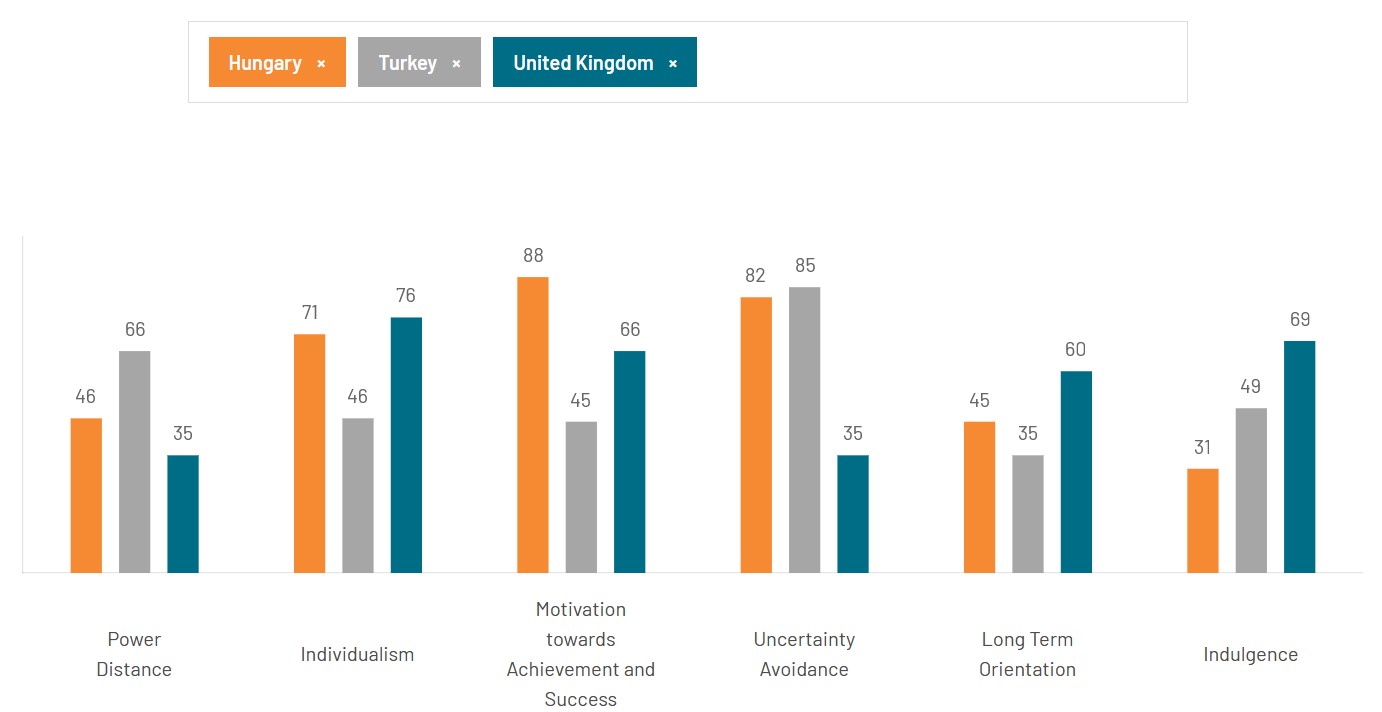
The evaluation tool puts nations on scales up to 100 (based on prior research of corporate culture internationally, and upon imperfect measurements, which often generalise).
The results have come as a slight surprise. I expected a way greater gap between Hungary and the UK with respect to Power Distance. Turkey – a society known to be rather autocratic historically, and dynastic in its family and company structure – is by far the most tolerant towards abuses and undemocratic uses of power, of the three.
Also interesting is the similarity between the UK and Hungary with regards to Individualism / Collectivism. It shows that Hungarians – just like the Brits – see themselves more as individuals than members of a religion, of a greater nation, a clan, or an extended family. In this area too, Turkish society appears more collectivist, perhaps a common feature of Islamic culture and close-knit extended families.
As for an undeniable similarity between Hungary and Turkey, we must look at how both nations seem to avoid uncertainty. The British appear to be more of a country of risk takers, tolerant of uncertainty, which plays a key role when deciding for new ventures, innovation, and enterprise. It needs little due diligence into current affairs to see that a large part of Hungarians either choose the constant uneventfulness of the Kádár era or the predictability of a national tradition, instead of reform and transformed social structures.
„Long-term orientation” is another important area, where Hungarians lie halfway between the two more populous countries. This factor is a key indicator when predicting social and economic future success. It is also where some leading communities have typically been East Asians and the Jews of the Diaspora. A common indicator of high values in this cultural area is a greater emphasis and investment in their children’s education, both financially and with time. Historically and world-wide, Jews and the Chinese, for example, have been known to value education beyond what is expected. One must note, however, that the basis of the diagrams has been corporate behaviour at management and employee levels. In that area, naturally, and British tradition – a functioning network of players for centuries – is definitely more willing to reinvest in its own organisations than taking a short-term profit than several eastern regimes or organisations.